.webp)
The Architectural Guide to Survival: How to Master Spatial Physics and Line Economy in Save The Dog
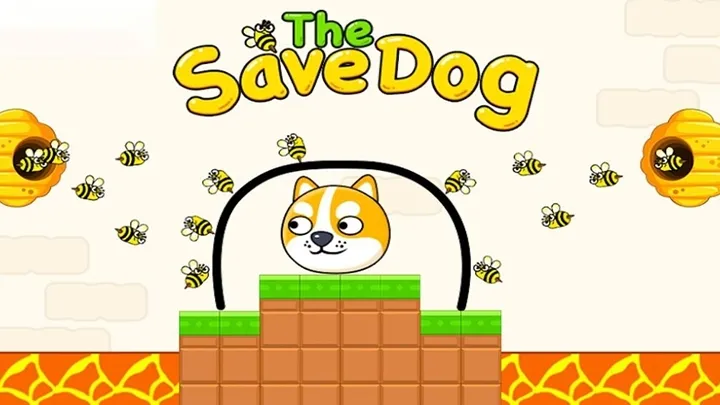
Save The Dog has captured the attention of puzzle enthusiasts worldwide by turning a simple, physics-based drawing prompt into an intricate exercise in structural engineering. The game's premise is deceptively straightforward: you must draw a single continuous line to shield a vulnerable dog from an aggressive swarm of bees for a strict ten-second countdown. However, beneath this casual visual presentation lies a highly volatile, punishing physics engine. The bees possess explosive kinetic energy, the environmental terrain is filled with lethal lava pits and spike hazards, and gravity constantly threatens to pull your protective structures apart.
To consistently solve these levels without running out of ink, you must look at the game past basic artistic doodles and view it through the lens of structural mechanics. Success requires an acute understanding of weight distribution, leverage points, and structural balancing. This step-by-step masterclass guide breaks down the essential architectural blueprints across ten chronological and strategic chapters. From understanding the core physics engine to mastering complex multi-threat late-game scenarios, this playbook will teach you how to draw with the calculated precision of an engineer.
1. Comprehending the Canvas: How to Master the Rules of Ink and Gravity
Before putting your finger to the screen, you must fully internalize the mechanical laws that govern the world of Save The Dog. The game operates under a strict dual-resource constraint: Ink Volume and Mass. The amount of ink you expend directly corresponds to the structural weight and thickness of the final drawn line. Drawing massive, sweeping cages might seem like a safe defensive strategy, but it expends massive amounts of ink, lowering your score and making the final barrier highly vulnerable to gravity-induced collapses.
Gravity activates the exact millisecond your finger leaves the screen. This means your drawn structure shifts from a static 2D vector asset into a dynamic physical object subject to tipping, sliding, and falling. To master the baseline canvas, you must learn to visualize the center of gravity of your drawing. A top-heavy shield will instantly flip over upon release, exposing your dog to the swarm, while a bottom-heavy baseline anchor will remain completely locked in place regardless of how hard the bees assault it.
2. Analyzing the Hive: How to Evaluate Attack Patterns and Kinetic Swarms
Every level begins with a static assessment period where you can track the exact placement of the dog and the surrounding beehives. To design an effective shield, you must understand how the bee swarm moves. The bees do not fly random routes; they possess a hyper-aggressive tracking AI that calculates the absolute shortest path to the dog's hitbox. They move with high initial velocity, packing immense kinetic force that can easily move unanchored lines across the screen.
Swarm Evaluation Checklist:
- Vector Pathing: Trace an imaginary straight line from the hive center to the dog to identify the exact point of primary impact.
- Velocity Scaling: Multiple hives mean simultaneous multi-directional pressure, which will split your structure if it lacks a centralized spine.
- The Seepage Factor: Bees will actively exploit microscopic gaps or loose ends in your line, using their compressed hitboxes to squeeze through structural openings.
3. Establishing the Anchor: How to Weaponize Environmental Geometry
The secret to structural stability in Save The Dog lies in the terrain itself. Most levels feature solid, immovable environmental elements such as rock platforms, flat ground planes, and rigid walls. A common novice mistake is drawing a floating capsule around the dog that does not touch these structures. A floating shield is at the complete mercy of the bees' pushing power, often resulting in your dog being pushed directly into a hazard or off the screen entirely.
To build an unmovable defense, you must learn the art of the "Structural Hook." This technique involves wrapping the ends of your continuous line around existing environmental corners or wedging them into tight crevices. By hooking your line onto a solid rock formation, you transfer the kinetic impact of the bees away from your drawing and directly into the unmovable map geometry. This allows you to create completely stable defensive barriers using only a fraction of your ink pool.
4. Crafting the Perfect Circle: How to Enclose the Target with Minimal Friction
When faced with a level featuring flat terrain and minimal environmental anchors, your optimal tactical approach is the execution of a perfect, tight enclosure. Enclosing the dog directly reduces the spatial volume the bees can target, forcing them to disperse their kinetic energy across a smooth, rounded surface. Sharp angles in your drawing create natural stress concentration points where the bees can focus their combined pushing power to tip the structure over.
To execute a flawless enclosure, start your line directly underneath the dog's chin, loop smoothly up and over the ears, and snap the line shut back at the point of origin. Keep the line as close to the dog's character model as possible without triggering a clipping penalty. This minimizes the total surface area of your shield, reducing the number of bees that can physically touch the barrier at any given millisecond while maximizing your post-level ink conservation rating.
5. Mitigating Toxic Terrain: How to Shield Against Lava and Spike Hazards
As you progress into the mid-game campaign, the difficulty scales dramatically with the introduction of lethal environmental hazards. Lava pools will instantly incinerate the dog upon contact, while spiked pits trigger an immediate level failure. The critical complication is that these hazards do not just affect the dog—they also affect your drawn structures. If a portion of your line slides into a lava pool, it loses its structural integrity, causing the remaining barrier to collapse inward.
To solve these hazard rooms, your drawing must fulfill a dual purpose: it must act as a bee shield and a physical seatbelt simultaneously. You must draw a wide, heavy base platform that physically wedges the dog into a safe zone, preventing the kinetic impact of the bee swarm from sliding the dog's avatar toward the hazardous boundaries. Think of your line as an architectural scaffolding system that actively locks the dog in place against external forces.
6. Defying the Law of Tipping: How to Balance Asymmetric Lines
Many advanced levels position the dog on narrow, elevated pillars or steep, angled slopes. In these environments, the primary threat is no longer just the bees, but the imminent risk of your dog slipping off the ledge due to gravity. The moment the bees strike your shield, they add intense asymmetric torque to your drawing, causing it to pivot wildly and pull the dog down with it.
Rules for Balancing Asymmetric Lines:
- The Counterweight Tail: Extend a long, heavy strand of ink down the opposite side of the pillar to act as a physical ballast, perfectly balancing the weight of the main shield.
- The Tripod Base: Create three small, distinct contact points with the ground terrain to establish a wide, unshakeable center of gravity.
- The Wedge Hook: Run your line into the tight vertex where the pillar meets the floor, jamming the structure to prevent any rotational movement.
7. Countering Multi-Hive Splits: How to Build Centralized Load-Bearing Spines
When a puzzle features three or four beehives positioned at opposing corners of the screen, your defensive architecture must evolve from a simple shield into a centralized load-bearing fortress. Multi-hive scenarios unleash a chaotic crossfire of kinetic energy. If your line is thin or lacks internal structural reinforcement, the opposing forces will bend and warp the drawing, opening up fatal gaps for the bees to swarm through.
To counter this multi-directional assault, you must implement a "Spine and Rib" drawing methodology. Draw a thick, centralized backbone line directly over the dog to absorb the primary downward and horizontal impacts. From this central spine, branch out smaller, curved defensive loops to redirect the incoming bee paths away from the dog’s vital hitboxes. This design ensures that the pressure from Hive A actively pushes the line into a tighter, more secure lock against the pressure coming from Hive B.
8. Advanced Line Economy: How to Achieve Three-Star Efficiency Ratings
Climbing the global leaderboards in Save The Dog requires more than just surviving the ten-second clock; you must do so with maximum three-star efficiency. The star rating system is directly tied to the ink meter at the top of the screen. If you use more than 30% of your total ink allocation, you are automatically downgraded to a two-star completion, even if your dog remains completely unharmed.
To maximize your line economy, you must master the art of the "Minimalist Pivot." Look for tiny, high-leverage geometric features on the map where a tiny line segment can yield massive structural results. For example, instead of drawing a massive cage around a dog sitting in a small pit, simply draw a tiny straight horizontal line across the top opening of the pit. By using the natural walls of the pit as your primary shield, you spend less than 5% of your ink while achieving an airtight, unbreakable defense.
9. Managing Late-Game Moving Hazards: How to Coordinate Dynamic Lines
The final tiers of puzzle design introduce active moving hazards, such as swinging axes, motorized pistons, and shifting platforms. These elements turn Save The Dog from a static physics puzzle into a dynamic, time-sensitive action game. You can no longer rely on static anchors because the very ground your structure rests upon is constantly shifting and changing its spatial coordinates.
When dealing with moving machinery, your drawing must be engineered with "Kinetic Tolerance." You must draw flexible, elongated loops that allow your protective cage to slide smoothly along with the moving platforms without getting crushed or clipped by passing pistons. Track the rhythmic movement cycles of the machinery before drawing, and launch your line during the exact window of maximum environmental clearance to ensure your structure doesn't get instantly pulverized by the stage mechanics.
10. The Psychological Edge: How to Prevent Input Panic and Drawing Errors
The ultimate hurdle to conquering the hardest levels of Save The Dog is overcoming input panic. As the puzzles become more complex, the urge to hastily scribble a massive, chaotic ball of ink over the screen becomes incredibly strong. This panic-scribbling style is highly inefficient, drains your ink bar instantly, and introduces completely unpredictable physics variables that usually result in catastrophic structural collapses.
To maintain your psychological edge, approach every new stage with a calm, systematic three-step mental loop: Identify, Anchor, and Execute. Take five seconds to study the map layout without touching the screen. Locate your primary environmental anchor points, trace your planned line path mentally, and then execute the drawing in a single, smooth, unhurried motion. A disciplined, slowly drawn line will always possess superior geometric properties and structural integrity compared to a frantic, rushed scribble.
Conclusion
Mastering Save The Dog is a deeply rewarding journey that transforms a simple mobile puzzle game into a masterclass of physics-based architectural engineering. By moving past chaotic doodles and systematically applying the rules of weight distribution, line economy, environmental anchoring, and counterweight balancing, you completely eliminate randomness from your gameplay experience. Success in this game is not determined by artistic talent, but by structural discipline. Every level is simply a geometric question waiting for an elegant, single-line answer. Take these foundational guides, study the unique terrain of every new stage, and draw your way to the top of the global leaderboards with the calculation, efficiency, and precision of a true structural master.